UIP Stewardship Rail 7 (IP)
Remnant Fieldworks has designed and filed the UIP Stewardship Rail 7 — a foundational portfolio of provisional patents that govern how invention assets are captured, protected, verified, controlled, and licensed without losing rights.
If the Core Rail 20 answers:
“How do we govern AI as an operator?”
Then the Stewardship Rail 7 answers:
“How do we govern power, ownership, disclosure, and licensing — so the assets can’t be taken, diluted, or quietly copied?”
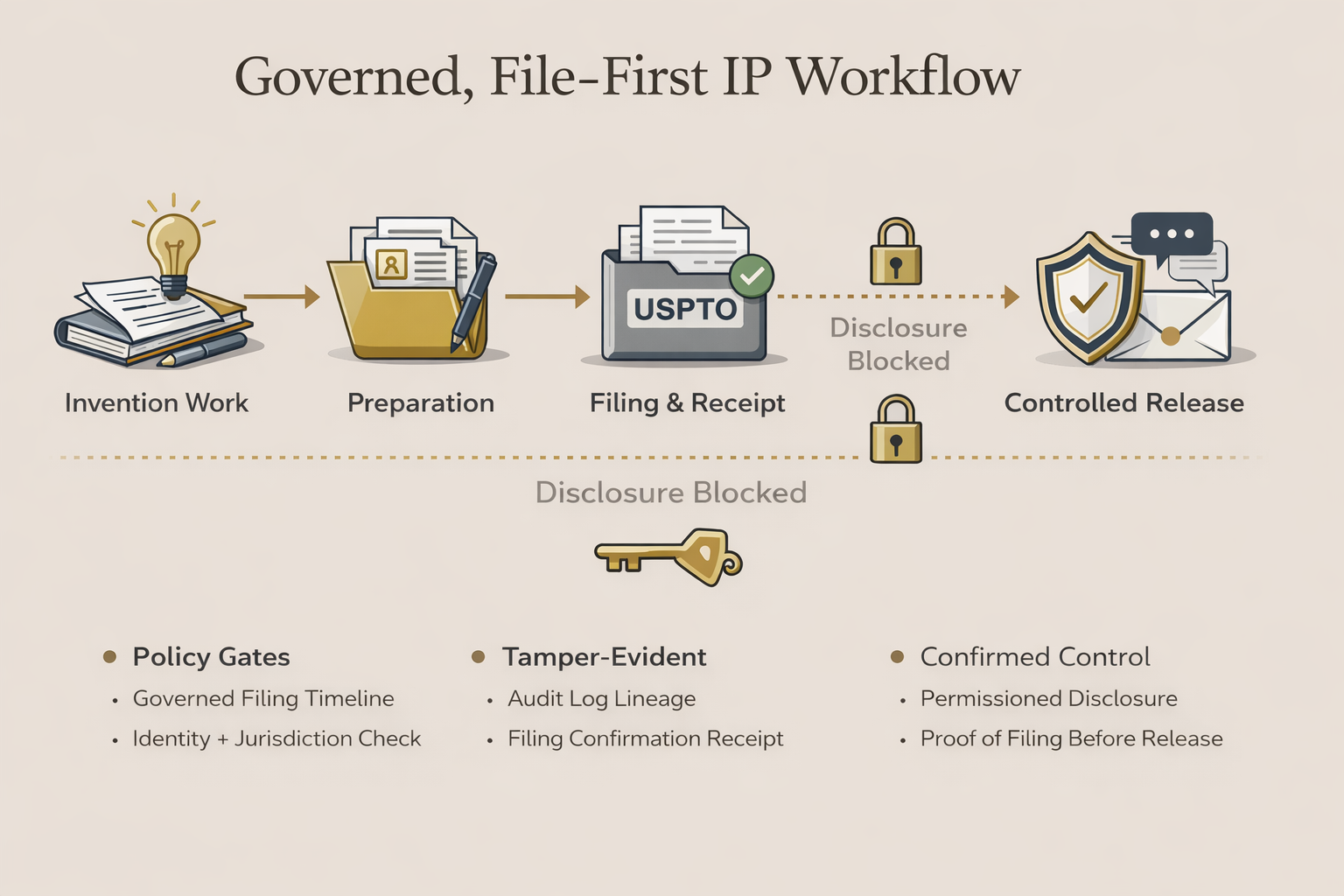
This rail is built for the real world: messy workflows, mixed platforms, third-party partners, and high-stakes IP. It is designed to keep invention value intact from first draft → filing → controlled disclosure → evidence → licensing.
WHAT THIS FILING WINDOW REPRESENTS
The Stewardship Rail 7 is not a collection of random ideas. It is infrastructure — the missing “governance layer” for invention stewardship.
These filings establish enforceable system patterns for:
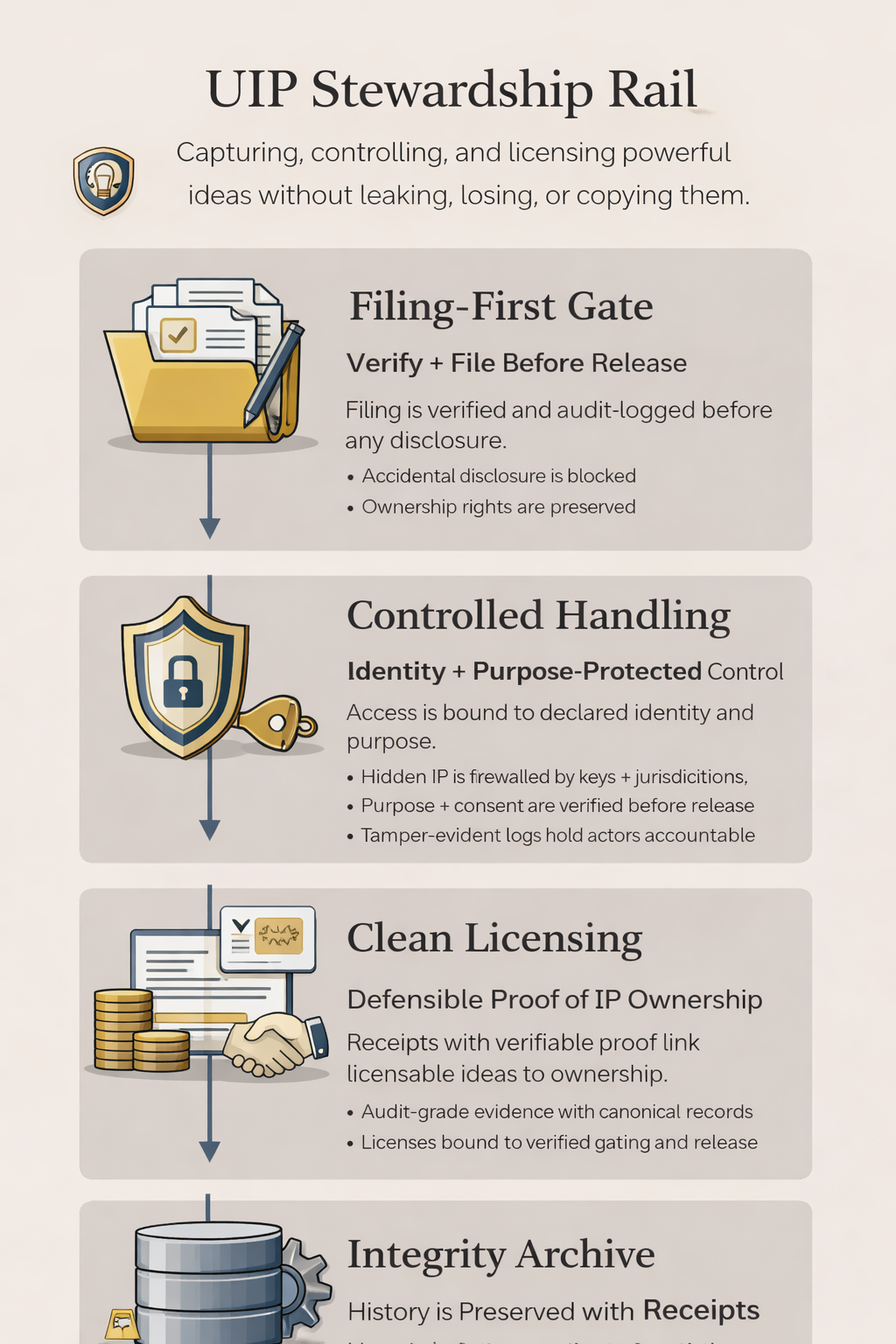
Filing-first behavior (no accidental novelty loss)
Policy-based disclosure gates (no uncontrolled sharing)
Identity + access-key governance (no casual access drift)
Evidence-grade documentation (proof packs that survive disputes)
Licensing rails (structured, auditable, enforceable commercialization)
Integrity archives (tamper-evident lineage across versions and time)
In plain terms:
This rail is designed so that valuable invention work can be stewarded and licensed without being leaked, stripped, or quietly repackaged by bigger players.
THE STRATEGY
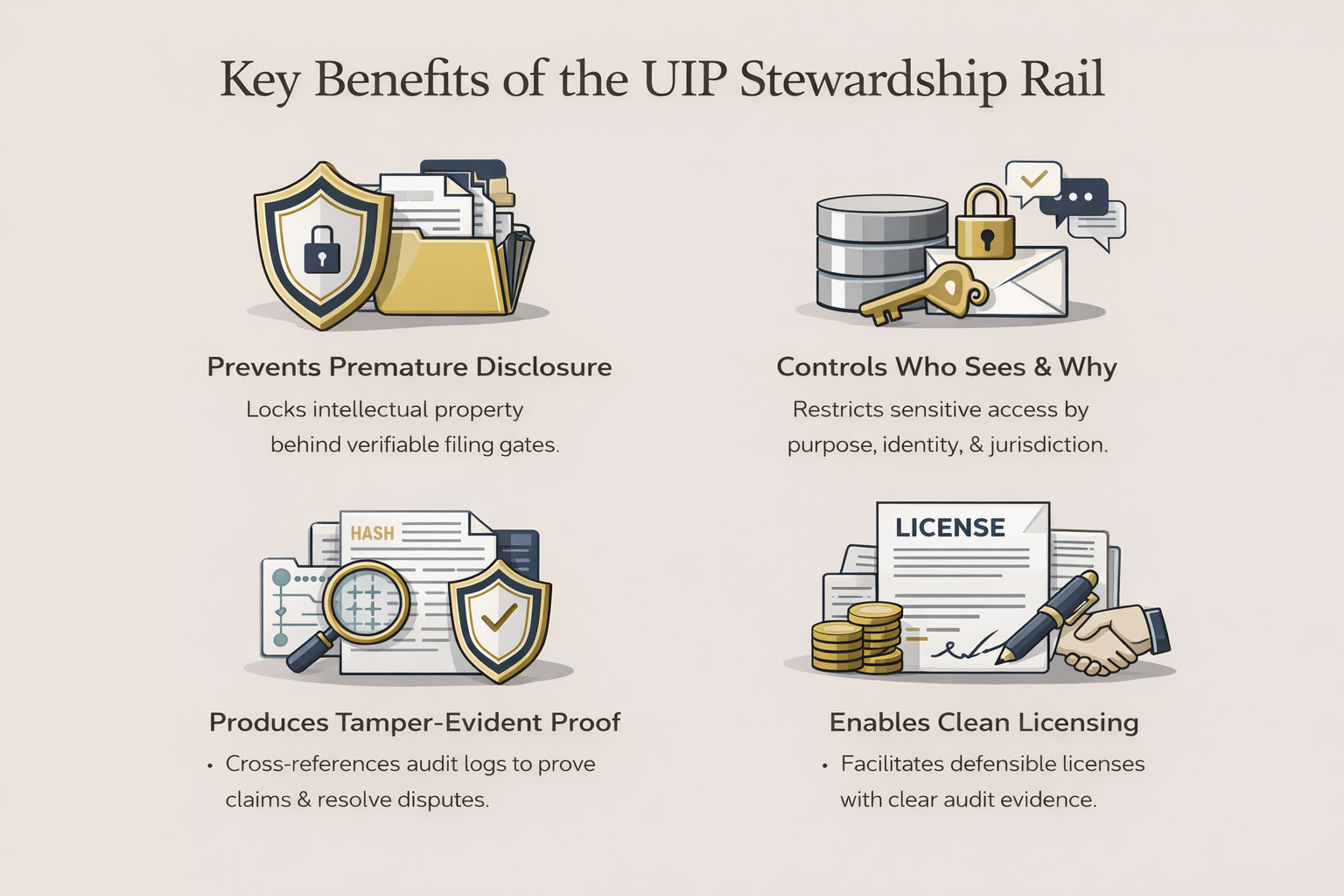
Most inventors lose money for one of three reasons:
They disclose too early (rights get weakened or lost)
They can’t prove lineage (no “receipts” when disputes happen)
They can’t license cleanly (no governance system buyers can trust)
The Stewardship Rail 7 is the counter-move:
it forces filing-first discipline
it binds disclosure to policy, purpose, and jurisdiction
it creates verifiable proof that holds up under pressure
it turns IP into something that can be licensed like infrastructure, not “ideas”
WHY FILE THIS RAIL AFTER CORE RAIL 20
The Core Rail 20 governs AI behavior in the world.
The Stewardship Rail 7 governs ownership, disclosure, and commercialization of the inventions themselves.
Together they form a complete loop:
Governed AI (Core 20) → must be owned and defended → Stewardship Rail 7
So the rail doesn’t just exist — it stays controllable, provable, and licensable.
THE UIP STEWARDSHIP RAIL 7 — MASTER LEDGER
Below is the public-facing ledger view (titles + internal docket tags).
Component titles are representative; underlying claims and embodiments are defined in filed provisionals.
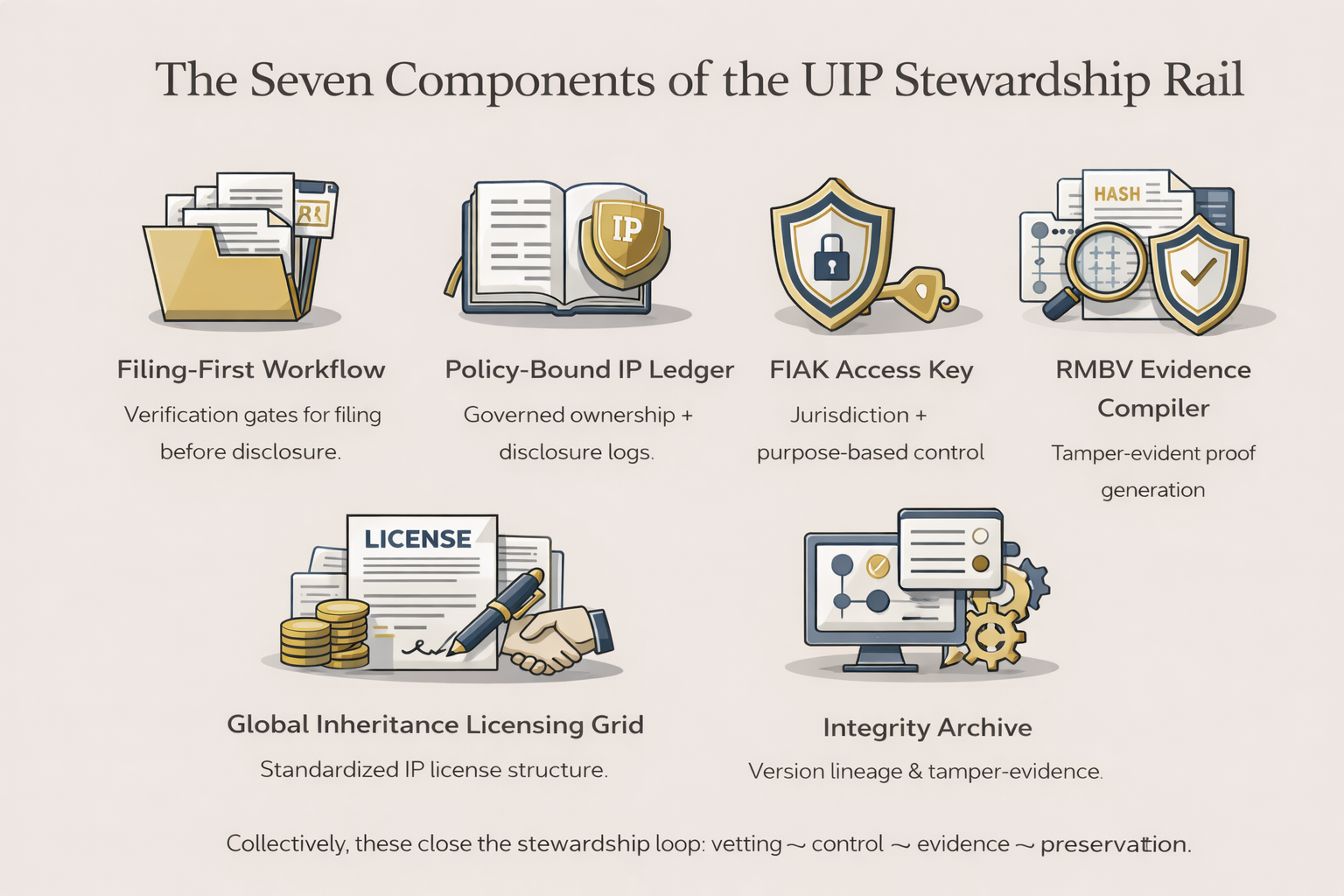
Filing-First Workflow (RF-STWDSHP-2026-FFW-01)
Policy-Bound IP Ledger (RF-STWDSHP-2026-PBIL-02)
FIAK Access Key (RF-STWDSHP-2026-FIAK-03)
RMBV Evidence Compiler (RF-STWDSHP-2026-RMBVEC-04)
Global Inheritance Licensing Grid (RF-STWDSHP-2026-LG-05)
Integrity Archive (RF-STWDSHP-2026-IA-06)
Stewardship Rail Component (RF-STWDSHP-2026-____-07)
WHAT THE STEWARDSHIP RAIL 7 DOES (5TH-GRADE VERSION)
Imagine you have a treasure map (your inventions).
If you show it to the wrong person too early, they can copy it.
So this rail builds:
a lock (filing-first gates)
a key (access control)
a rulebook (policy engine)
a receipt printer (evidence compiler)
a vault (integrity archive)
a storefront contract system (licensing grid)
So your invention work can be shared only the right way, at the right time, with proof.
One sentence:
“The Stewardship Rail 7 makes sure invention work doesn’t get stolen, leaked, or diluted — and makes it licensable with receipts.”
WHY THESE 7 ARE SPECIAL
Because they create a defensible chain:
Filing happens first
Disclosure is gated by verified filing
Access is controlled by keys + policy
Every action leaves evidence
Licensing becomes structured and enforceable
History becomes tamper-evident
The whole system works across platforms
This is not just “paperwork.”
It’s a stewardship machine.
A STATEMENT OF INTENT
Remnant Fieldworks exists to ensure that powerful systems and valuable work remain accountable — and that stewardship is real, not symbolic.
These filings are an act of:
stewardship, not domination
responsibility, not coercion
protection, not extraction
We do not build for weaponization, surveillance abuse, or coercive control.
We build for governance, integrity, lawful stewardship, and long-horizon benefit.